
Throughout this article, interviewer, DeLuca, asks questions that address the ways ins which the issue of global climate change is framed for the media, and thus the public, the role of the media in representing environmental issues in the public sphere, and communication and imaging strategies that Greenpeace uses to get it's messages out into the public.
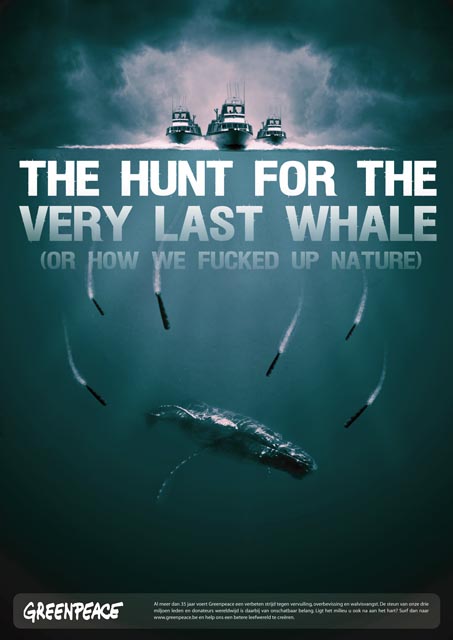
What I felt was important to take from this article, through my interpretation, and class discussion, is the question of how effective media, and groups like Greenpeace are at communicating their messages to us, the general public. A lot of the people in class talked about their issue with the way that groups like Greenpeace present their goals, in that sometimes they seem to complex, or too "big" for us to solve. Images in Greenpeace ad's although most often, are astonishing, and catch the viewers attention, usually thats all that they do - in my opinion. Since they show such big issues, in such media-image effective ways, they do their job at getting attention - what they could, however, do better at - is creating effective messages and images, that while catching public attention, also provide solutions, and push people to act... by giving them ideas of how THEY CAN make a difference, not just showing the problem in the most exciting and captivating way possible.
In the second article for this week, "The Structure of Social Movements: Environmental Activism and its Opponents" Author, Luther P. Gerlach, discusses the topic of social movements from a Network Perspective and provides a really good summary of the organizational strategies that work to characterize the different aspects of Segmented, Polycentric, and Integrated Networks that he identifies as found in most American social movements. This article works to highlight the shift there has been from a centralized and/or bureaucratic organizational structure to one that is segmentary, polycentric, and an integrated network and calls this new type of organizational structure a SPIN organization.
SPIN's have many benefits, not just for social networks but as this article highlights for environmental movements as well.
The most vital part of this article, i find, is the description of the ways ins which social movements, like the environmental movement can be described as "NETWORKED". In modern times, it is important to recognize the complexity of any type of movement, with all the available tools for these groups to mobilize, communicate and work with one another and the public. These organizations with available technologies and communication tools are diverse and in no way isolated from one another, they form integrated networks, and are complex in their relationships. New networking possibilities, i feel completely define the movements of the present age. Networking enables movement participants to exchange information and ideas with one another, and allows them to coordinate participation, in some cases around the globe allowing for joint action and communication. Groups and movement members, are not only linked through networks internally, but with other movements externally, with other participants who share attitudes or values on similar issues - through these links movements can draw material support, can recruit new supporters and participants, and expand coordination for joint and increased action.
I feel as if Networking is what holds all the other characteristics: segments, polycentric aspects, and linkages, together.

 I found that this article was really interesting in the way in which it described the internal and external aspects of environmental movements, it's easy to see the things they do through the media, in the news etc, but it's interesting to see how they come together and work. Overall it highlighted the way in which SPIN organizational structure, helps participants to challenge and change the dominant order and to survive with the immense amount of competition and challenges they face. It argued for the ways in which this type of organizational structure is innovative and strong from the inside out, and may very well be the organizational form of the future, one which is best suited to communicate and work to progress this need to manage globally and locally based organizations for the common good.
During this class, Jenn Good showed a number of environmental campaign videos from Greenpeace. These were really effective in communicating their messages on the level that, as i stated before, catching the attention of the viewers and really pulling at their emotions. They were both visually and emotionally exciting. On the other hand, however, I feel that in viewing these my point from earlier was, at least for me, supported - the fact that although these are exciting- and VERY successful at catching the attention of viewers and getting them to watch and listen to their msg - they seemed TOO powerful TOO big - without offering ANY Solution.
There was an exception, however. The video shown about the dove products, with the little girl - did the opposite and i found was a template for what these campaigns should work to do, and how they should communicate to the public. It gave us a PRODUCT and a SOLUTION. By showing how harmful a certain product was that people go to the grocery store around the corner and buy - and giving statistics on how harmful this was - it allows us an option to make a choice that makes a difference... we can go and consciously choose not to buy this product now that we know how harmful it is. Instead of just showing us visually exciting and sad images of whales dying and forests burning.
Another example of an effective Ad i've seen recently from Greenpeace, which uses the same effective technique, of providing solutions by giving a more specific action that we can do :

Again, by providing a real product in a simple way a solution is also provided for the average citizen.

No comments:
Post a Comment