
In the article ""Somethin' Tells Me It's All Happening at the Zoo": Discourse, Power and Conservationism" Tema Milsteim examines the way that Western institutional discourses work to reproduce human relationships with nature, focusing specifically on the institutional setting of the ZOO. Milsteim’s goal is to generate useful and productive questions and possible alternatives that position the zoo as a possible site for greater human-nature connection and positive action.
What really struck interest for myself within this article was Milsteim's discussion of the elements of gaze and power in regards to human's relationship with the animals within the Zoo's institutional setting. Within this discussion Milsteim argues that the zoo is not only shaped by discourses, but as a symbolically material cultural site, it also serves to shape discourse.
Milsteim States:
"The exhibition of animals, the central function of zoos, is a process of power wherein "almost total control is exercised by humans over animals' movements and activities, with minimal oportunity for the animal to excercise its own preferences and priorities" (p.88).
Milsteim is arguing that in this kind of context the zoo’s visitor’s gaze, which she compares to Foucault’s panoptic surveillance type gaze, is completely related to power, leaving powerless (animals) at all time subject to the gaze of the powerful (humans). Milstein is proving here that the zoo animal is always a captive object to the human subjective gaze. The human is always free to leave, and the animal is always trapped- so visitors at the zoo get to gain pleasure, knowledge, power and entertainment from the trapped animals, but are ignorant and protected from the real feelings that they should be feeling regarding the fact that these animals are trapped and dominated by humans.

I have always felt bad for animals at the zoo, when I have seen them tied up, or in a cage, but at the same time, I’ve paid to visit zoo’s and places like Marineland as a form of entertainment and a pastime activity. This article, and particularly the section I’ve highlighted above has caused me to look at this in a different way. I’ve learned about the gaze in other communication classes throughout my university experience, but would have never thought to apply it to something like this.
In class there was a discussion regarding the opposing viewpoints about places like Zoos and Marineland and different zoos viewed as raising awareness and producing knowledge against arguments about them being harmful and inhumane. I noticed that myself and most of my classmates had all gone through experiences in which we encountered animals within the institutional settings of places like Marineland and Zoos and I think reading this articles really transformed the way we looked at these experiences. Although many expressed that initially or as young children they had experienced a type of somber experience as they grew older and began to realize what they were really witnessing within these different types of zoos.
Another Type of Eco Tourism:
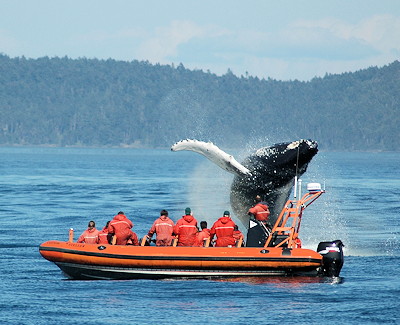 Another reading for this week by Milsteim "When whales "speak for themselves": Communication as a mediating force in wildlife tourism" stresses the prevalence of ecotourism and explores how communication can serve as a mediating source of human - nature relations in increasingly growing sites of intersecting cultures and natures. The study in this article looks at wildlife tourism with a specific focus on whale watching tourism. Here Milsteim highlights the ways in which Westerners in a wildlife tourism setting, like Whale watching, may value silence as communicative of a co-expressive existence with nature, and points out that this may lead to frustration by the limitations of cultural tools of language in conveying particular knowledge's of or experiences with nature.
I thought it was very interesting that Milsteims study highlighted the fact that many people valued the absence of verbal human communication as instrumental in knowing and participating with nature. This make sense, often the most meaningful experiences in one life, i find at least, are the hardest to put into words, and this could apply to many aspects of ones life, and ecotourism more generally. Also in this article the author emphasizes the fact that with whale watching specifically, although whales may "speak for themselves" and through their iconic status, the extent to which human listeners perceive their relations with nature is both culturally and situationally dependent. This article helped me realize why silence would be important, and why some environmental activists adamant about the limitations of language, language is completely culturally and contextually dependent and it can also be used negatively to promote certain types of ecotourism that are problematic.
The paper was meant as a larger conversation within environmental communication and interdisciplinary circles within which the main objective is to study the ways in which communication (as a cultural text) mediates human relations with nature - and it has definitely made me more aware AND critical of the ways in which different types of eco and nature tourism is represented and promoted.
Below is an ecotourism advertisement and a link to the International Ecotourism Society's webiste:
I thought it was very interesting that Milsteims study highlighted the fact that many people valued the absence of verbal human communication as instrumental in knowing and participating with nature. This make sense, often the most meaningful experiences in one life, i find at least, are the hardest to put into words, and this could apply to many aspects of ones life, and ecotourism more generally. Also in this article the author emphasizes the fact that with whale watching specifically, although whales may "speak for themselves" and through their iconic status, the extent to which human listeners perceive their relations with nature is both culturally and situationally dependent. This article helped me realize why silence would be important, and why some environmental activists adamant about the limitations of language, language is completely culturally and contextually dependent and it can also be used negatively to promote certain types of ecotourism that are problematic.
The paper was meant as a larger conversation within environmental communication and interdisciplinary circles within which the main objective is to study the ways in which communication (as a cultural text) mediates human relations with nature - and it has definitely made me more aware AND critical of the ways in which different types of eco and nature tourism is represented and promoted.
Below is an ecotourism advertisement and a link to the International Ecotourism Society's webiste:
International Ecotourism Society: http://www.ecotourism.org/site/c.orLQKXPCLmF/b.4832143/k.CF7C/The_International_Ecotourism_Society__Uniting_Conservation_Communities_and_Sustainable_Travel.htm

I view the Inernational Environmental Society as a positive outlet of promoting ecotourism, and the ways in which it does so in a environmentally productive manner is illustrated in their Mission Statement from this site:
Mission:
TIES promotes ecotourism, which is defined as "responsible travel to natural areas that conserves the environment and improves the well-being of local people," by:
- Creating an international network of individuals, institutions and the tourism industry;
- Educating tourists and tourism professionals; and
- Influencing the tourism industry, public institutions and donors to integrate the principles of ecotourism into their operations and policies.
Vision:
As the world's oldest and largest international ecotourism association, TIES seeks to be the global source of knowledge and advocacy uniting communities, conservation, and sustainable travel.
As the world's oldest and largest international ecotourism association, TIES seeks to be the global source of knowledge and advocacy uniting communities, conservation, and sustainable travel.

No comments:
Post a Comment