Tuesday, 25 October 2011

Consumerism,Materialism and effects on the Natural Environment

 "...sustainability issues are the historical result of the prevailing belief within Western Industrial societies that both firms and consumers are self-interested critics, with consumers maximizing utility through consumption and with firms maximizing profit through meeting the demand. The belief that the road to happiness is through consumption ignores the fact that the resources for consumption are limited and the consumption of the limited resources are not equal globally." 

The statement above is from the article "Sustainability and Consumption"within which authors Huang and Rust explore the ways in which aspects of sustainability should affect the overall consumption behavior of consumers, charitable aid to poorer countries, and responsible environmental practices by businesses. They create and present a model that enables them to provide what they feel implications would be for consumers, society and business.


One of the statistics in this article that shocked me:
"Consumers in the industrialized nations consume more than 80% of the limited natural resources."


The authors argue that as a result of this immense consumption, consumption inequity has become a significant source of global tension.

All this leads to their argument which outlines the sum of their whole article: that this consumption inequity gives rise to the advocacy of sustainable consumption whereby each person should consume only their "earth share"in order to make the consumption socially equitable and ecologically sustainable.

The authors lay out a model in this article, that shows how consumers, business and governments interrelate with respect to sustainability, and consumption, this model attempts to derive optimal behavior for consumers and business with respect to decisions about consumption environmental sacrifice, charitable aid and use of green technology.


I found this part of the article very interesting and useful. What they are expressing here the substance of their theory, which is that there is three main dimensions to sustainability, 1)consumer/societal happieness and standard of living, 2) corporate profit and pollution and 3) geological issues like global conflict. Their layout and description of each of these dimensions and the variables that link them were productive. BUT i found that their results section which should be the strongest part of their article somewhat lessened the credibility of their argument. The results that they stated seemed very obvious and the authors lost me at this point, although i can see the importance of how they got to these results and the importance of their discussion to the overall discourse surrounding sustainability consumerism and the natural environment.

"Shop 'til We Drop? Television, Materialism and Attitudes about the Natural Environment" really changed my view of how effective Television really is on general opinion and discourse surrounding many issues, but specifically environmental ones. The article emphasizes how important research is that speaks to how indivisuals form their sense of relationship with the natural environment, in the modern heavily mediated society. I would have never though that TV plays such an invasive role on attitude formation on environmental attitudes. Perhaps this is from my years of studying communication and being taught that consumers are much more conscious than often given credit for, and that we don't just consume messages and believe what we tell us. HOWEVER, this article sheds a new light on this issue, and points it in a different direction, one that views materialism as a mediating variable between television viewing and environmental attitudes.

Television is built on the premise of materialism, it exists overall to make a profit, as the article states :
"At a fundamental level, commercial television exists because of an arrangement between those who create television, those who wish to advertise on television, and those who view television. Television assembles audiences, and advertisers buy those audiences to sell goods and services." 

The article states how advertising is a major source of promoting materialism, and plays a huge part of creating a consumer culture. It also argues that not only advertising, but television more generally transmits information about materialism, and promotes positive images,narratives, and messages about materialism.

In this article: The argument thus is that television viewing is related to lower levels of concern about the natural environment, as television viewing is positively related to materialism,and environmental attitudes are negativley related to materialism. And the question asked is "Does materialism mediate the relationship between television and attitudes about the natural environment?"... both the argument and the research question find support and validation throughout the research presented.

This study provided a new type of outlook on the power of television, and the price society's interest and dependence on it has on the natural environment.

Finally, Salvador's deconstructs the problematic issues within the Green Consumerism movement, and highlights the fact that books such as "The Green Consumer" and many others within the movement, argue that environmental problems demand changes in the everyday practices of consumers. But on the other hand, it simultaneously advances the view that intrinsic and substantial changes to consumer habits are not needed. These types of arguments obscure the correlation between the dimensions of a problem and the effort needed to correct it. This article works to expose several contradictions manifest in the book "The Green Consumer" primary claims and asses the implications of such contradictions for the broader environmental movement. The article overall concludes that while Green consumerism offers a potentially valuable measure for immediate action, it at the same time severely risks limiting more substantial and long term reform in the relationship between consumer society and the environment.

Discussions regarding this article in class surrounded the fact that they could see the ways in which the Green movement is becoming so popular in pop culture and all different types of products that are being mass circulated, because it is asking us to do what we're best at, consume.
Consumerism and the Environment: Information is power

Monday, 24 October 2011

Greenwashing and Green Marketing


Today in class we discussed issues surrounding Greenwashing and Green marketing. Before this class I didn't know a lot about this topic and the discussions/ 4 articles assigned opened my eyes to the vast amount of Greenwashing that I am exposed to on a daily basis. It also has made me more aware and critical of these advertisements and marketing strategies.

In the "Let It Green: The Ecoization of the Lexicon" I liked it how it outlined the green movement's beginnings, it is interesting to find out where something that we are so used to seeing on a daily basis , all started from, and also realizing that it was quite some time ago that this trend started, and also realize how much it has been exaggerated with new media, and all the new available technological platforms from food labels to television commercials to social media advertisements. It is also interesting to see how the insertion of green into language transformed from being rooted in environmental battles to being branched out into a form of marketing.

The other part of this article that i found very interesting, was the way in which it discussed the word "eco" as being exploited. Benz states that:

"...eco- no longer refers to concern for the environment primarily because savvy marketers have exploited eco's original green connotations and have affixed eco- to the front of their products in an effort to sell more units, to increase consumption of their products- anit-eco actions to say the least."

In class we looked at a lot of hummer ad's, and a lot of the discussion surrounded these different ads. As we were going through these ad's and as I was listening to these comments I thought to myself, that just as the word "eco" is exploited in rhetoric, eco-like images, like green landscapes, beautiful natural scenery, and other green images are exploited visually in television, magazine and internet advertisements through the images we are presented with alongside the products. 

An example of an advertising campaign for the cleaning product "green works" was shown. The discussion surrounding this video everyone's really connected to the "Greening of Products" article. This article presented a study that used Information Manipulation Theory as a framework to understand participants (and people's, more generally) evaluation and perceptions of green advertisements. This article points out that many consumers are skeptical towards green glaims which hinders the products effectiveness. Within this study one of the main findings was that Quality ( expectations about the truth of the information) was hugely associated with honesty and positive attitudes towards advertisements. When discussing the video shown for "Green Works" most of the responses from students were regarding the fact that they couldn't even tell it was an advertisement until they saw the product placed throughout the video a few times, and at the end the product name came up and it became obvious it was an advertisement. This response was often followed by how effective they found the advertisement to be. I found it really interesting how much a real life situated paralleled the research presented in this article. 

Below is a link to the Green Works video shown in class:


A third article assigned for this week, "Communication Business Greening and Greenwashing in Global Media" explored the ways in which knowledge about  greenwashing is communicated in the specialized discourse of a CNN's Greenwashing video, to show the ways that processes of knowledge selection are employed for shaping public awareness and understanding of environmental issues. This article is useful because it illustrates the communicative tactics and downfalls displayed by different organizations.  It argues the ways in which the environmental organizations activities and the consumers attitudes are legitimated and evaluated in order to provide a legitimate base for the specific product and advertisement. However the article takes issue with the fact that the greenwashing companies are not given a voice or legitimizing any of their claims, which leads to a imbalanced and unreliable discourse. This article is important, in a class which is focusing on the communication of environmental issues, because it highlights, relating to the last article, why people may be skeptical about all of these green advertisements that they are being so constantly bombarded with. Since they are not confronted with any kind of verbal legitimations, they are given nothing to counterbalance the delegitimizing opinions of criticism and environmental experts.

For my artifact this week i found a number of sites concerned with greenwashing. These sites all have a common goal, to raise awareness and create critical awareness around greenwashing throughout the media. They all give different examples of greenwashing as well as provide information surrounding environmental causes, the harmful effects of techniques like greenwashing, etc.


Thursday, 20 October 2011

Throughout the semester, espeically last week, we talked about eco tourism, animals in zoos , if this is write or wrong, etc.

Alot of what was brought up was that human traits seem to be characterized onto these wild animals, because of children books, movies etc. And so when animals, act wild, like animals, they are killed, or demonized... when in fact this is their nature, and by taking them out of the habitat and placing them in to a constructed one, expecting them to act in a way that they are not built to, that is a constructed view that animals cannot live up to, and many times are punished for not living up to.

Why im posting this is because getting ready for school this morning, i saw a news clip on the Today show, regarding animals that had been let loose from a conservervation or perserve in Ohio, before the owner killed him. The newscaster stated... all of these animals have been accounted for, and most killed.. as many environmental activists state was the only choice.

It is the only choice? To kill animals that were taken out of their natural environment and put into a synthetic one... and then let loose into our environment by a human? Doesnt sit right with me.

Overall, just thought it really fit with what this class is about.

Below is a clip from a different news station reporting on the event.

Monday, 17 October 2011

Eco Tourism

In the article ""Somethin' Tells Me It's All Happening at the Zoo": Discourse, Power and Conservationism" Tema Milsteim examines the way that Western institutional discourses work to reproduce human relationships with nature, focusing specifically on the institutional setting of the ZOO. Milsteim’s goal is to generate useful and productive questions and possible alternatives that position the zoo as a possible site for greater human-nature connection and positive action.

What really struck interest for myself within this article was Milsteim's discussion of the elements of gaze and power in regards to human's relationship with the animals within the Zoo's institutional setting.  Within this discussion Milsteim argues that the zoo is not only shaped by discourses, but as a symbolically material cultural site, it also serves to shape discourse.

Milsteim States:
"The exhibition of animals, the central function of zoos, is a process of power wherein "almost total control is exercised by humans over animals' movements and activities, with minimal oportunity for the animal to excercise its own preferences and priorities" (p.88).

Milsteim is arguing that in this kind of context the zoo’s visitor’s gaze, which she compares to Foucault’s panoptic surveillance type gaze, is completely related to power, leaving powerless (animals) at all time subject to the gaze of the powerful (humans). Milstein is proving here that the zoo animal is always a captive object to the human subjective gaze. The human is always free to leave, and the animal is always trapped- so visitors at the zoo get to gain pleasure, knowledge, power and entertainment from the trapped animals, but are ignorant and protected from the real feelings that they should be feeling regarding the fact that these animals are trapped and dominated by humans.


I have always felt bad for animals at the zoo, when I have seen them tied up, or in a cage, but at the same time, I’ve paid to visit zoo’s and places like Marineland as a form of entertainment and a pastime activity. This article, and particularly the section I’ve highlighted above has caused me to look at this in a different way. I’ve learned about the gaze  in other communication classes throughout my university experience, but would have never thought to apply it to something like this.

In class there was a discussion regarding the opposing viewpoints about places like Zoos and Marineland and different zoos viewed as raising awareness and producing knowledge against arguments about them being harmful and inhumane. I noticed that myself and most of my classmates had all gone through experiences in which we encountered animals within the institutional settings of places like Marineland and Zoos and I think reading this articles really transformed the way we looked at these experiences. Although many expressed that initially or as young children they had experienced a type of somber experience as they grew older and began to realize what they were really witnessing within these different types of zoos.

Another Type of Eco Tourism:
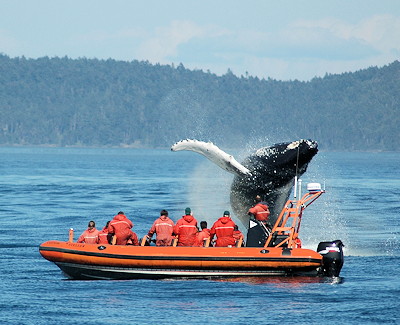
Another reading for this week by Milsteim "When whales "speak for themselves": Communication as a mediating force in wildlife tourism" stresses the prevalence of ecotourism and explores how communication can serve as a mediating source of human - nature relations in increasingly growing sites of intersecting cultures and natures. The study in this article looks at wildlife tourism with a specific focus on whale watching tourism. Here Milsteim highlights the ways in which Westerners in a wildlife tourism setting, like Whale watching, may value silence as communicative of a co-expressive existence with nature, and points out that this may lead to frustration by the limitations of cultural tools of language in conveying particular knowledge's of or experiences with nature.

I thought it was very interesting that Milsteims study highlighted the fact that many people valued the absence of verbal human communication as instrumental in knowing and participating with nature. This make sense, often the most meaningful experiences in one life, i find at least, are the hardest to put into words, and this could apply to many aspects of ones life, and ecotourism more generally. Also in this article the author emphasizes the fact that with whale watching specifically, although whales may "speak for themselves" and through their iconic status, the extent to which human listeners perceive their relations with nature is both culturally and situationally dependent. This article helped me realize why silence would be important, and why some environmental activists adamant about the limitations of language, language is completely culturally and contextually dependent and it can also be used negatively to promote certain types of ecotourism that are problematic.

The paper was meant as a larger conversation within environmental communication and interdisciplinary circles within which the main objective is to study the ways in which communication (as a cultural text) mediates human relations with nature - and it has definitely made me more aware AND critical of the ways in which different types of eco and nature tourism is represented and promoted.

Below is an ecotourism advertisement and a link to the International Ecotourism Society's webiste:


International Ecotourism Society: http://www.ecotourism.org/site/c.orLQKXPCLmF/b.4832143/k.CF7C/The_International_Ecotourism_Society__Uniting_Conservation_Communities_and_Sustainable_Travel.htm


I view the Inernational Environmental Society as a positive outlet of promoting ecotourism, and the ways in which it does so in a environmentally productive manner is illustrated in their Mission Statement from this site:


Mission:
TIES promotes ecotourism, which is defined as "responsible travel to natural areas that conserves the environment and improves the well-being of local people," by:
  • Creating an international network of individuals, institutions and the tourism industry;
  • Educating tourists and tourism professionals; and 
  • Influencing the tourism industry, public institutions and donors to integrate the principles of ecotourism into their operations and policies.
Vision:
As the world's oldest and largest international ecotourism association, TIES seeks to be the global source of knowledge and advocacy uniting communities, conservation, and sustainable travel.


Sunday, 16 October 2011

Spinning Climate Change


The Corbett and Durfee article from this week, “Testing Public (Un)Certainty of Science: Media Representations of global Warming” the authors discuss the fact that the general public’s understanding of science and technology are critical for societies that are increasingly effected by scientific developments and policies influenced by scientific expertise. They emphasize the fact that for most of the general public this knowledge comes from the mass media and it’s various outlets. This proves especially true for issues like climate change, which the average everyday person doesn’t have a lot of experiential knowledge or experience with that would help shape their opinions. This article specifically focused on media portrayals and public opinion and understanding of climate change with the goal of researching the actual audience response to journalistic discourse of global warming. Their research found that context was very important in audience understanding of climate change.

What this article is emphasizing is that the media really does effect our opinion, and that the average citizen watching the nightly news or reading the paper in the morning, or on their homepage, most likely wont do background research to check up on what they are reading, hearing and seeing.
There is a definite Uncertainty among the general public, and it was obvious even throughout the discussions in class this week. I think that the two video’s shown, the one attacking AL Gore and his campaign and the other highlighting the ignorance toward climate change, really emphasized and highlighted to myself at least, the UNCERTAINTY I feel, and many of my peers feel because of the vast amount of mixed, and completely opposing messages we are getting on a daily basis. Obviously being young adults, without much exposure to the issue, thus having a lot of uncertainty about it, we would be more swayed by what we are seeing, but the difference in videos, and how convincing each seemed stressed the importance of CONTEXT as well. 

Overall left me feeling overwhelmed and disappointed.

The second article “Spinning Climate Change” examines the critical role P.R plays in the debate about climate change, it documents the fluid role of professionalized communication and communication tactics in terms of the impact on corporate and NGO actors and their activities. Through this article, like the first, we can see the effect P.R has on public perspectives regarding climate change.

What I found really interesting and that struck me in this article was when it discussed the David Scuzki foundation using the same P.R firm that works with and advised key players in the Alberta Oil Sands. This is puzzling, because it seems contradictory that a foundation as productive and committed to promoting a healthy environment and positive environmental action, would be associated with a P.R firm with connections to something so harmful for the environment. This is where concerns about P.R come in with their bottom line, as long as they spin successfully that’s all that matters. Is it a negative thing that the foundation is linked to them, or positive because they are making movies to more modern techniques of getting their information out?
 
The David Letterman interview with McKibben that were assigned to watch this week highlights the prominence of environmental issues within the popular culture circuit at this point in time, which highlights the importance of the articles and their arguments this week. Environmentalism is no longer an issue only popular among a certain segment of the culture it is becoming a very popular issue and so it is important to analyze and be critical about the weays in which it is being communicated to us.

That said, the 2 video’s shown this week illustrate this point even further. The first worked to highlight the ways in which media is hyping up and sensationalizing environmental issues, specifically climate change, showing a variety of news clips in a context which makes the argument seem legitimate.

Then Jennifer showed up the next video, which was contextualized to prove the complete opposite.

These videos really resignated with me because after seeing the first, I stepped back and wondered to myself, is it really as bad as it seems?? As I have been thinking it is? And by showing the second video Jennifer REALLY emphasized and showed that the media can spin anything to make people question what they know, and what they’ve thought in the past. Yes it is bad, but its easy for it to be spun in the complete opposite way – especially for people who aren’t being educated to be critical of newscasts like this.

This is a REALLY important issue and its really made me rethink and become EXTREMELY critical of what I’m viewing – from BOTH sides.

The following video illustrates different views on climate change – but contextualizes it by speaking over and narrating different parts of the videos with both text and voice overs. It places two advocates for different sides of the debate against each other, and works to make one seem less knolwedgable than another. Just one example of hundreds you can find with a simple youtube search...